

Bring Back Shame, Low-Value Human Capital, Resilient Communities, Millennial Brands, OpenAI, Gen Z and Truth
Conversations of the Week: May 22, 2026

Low-value human capital
The Standard Chartered CEO spent the week trying to recover from this comment, which, to add insult to injury, reads like it was drafted with AI:
“It’s not cost cutting; it’s replacing in some cases lower-value human capital with the financial capital and the investment capital we’re putting in,” Chief Executive Officer Bill Winters said at a press briefing in Hong Kong, adding that affected staff would receive ‘good clear notice’ ahead of time.”

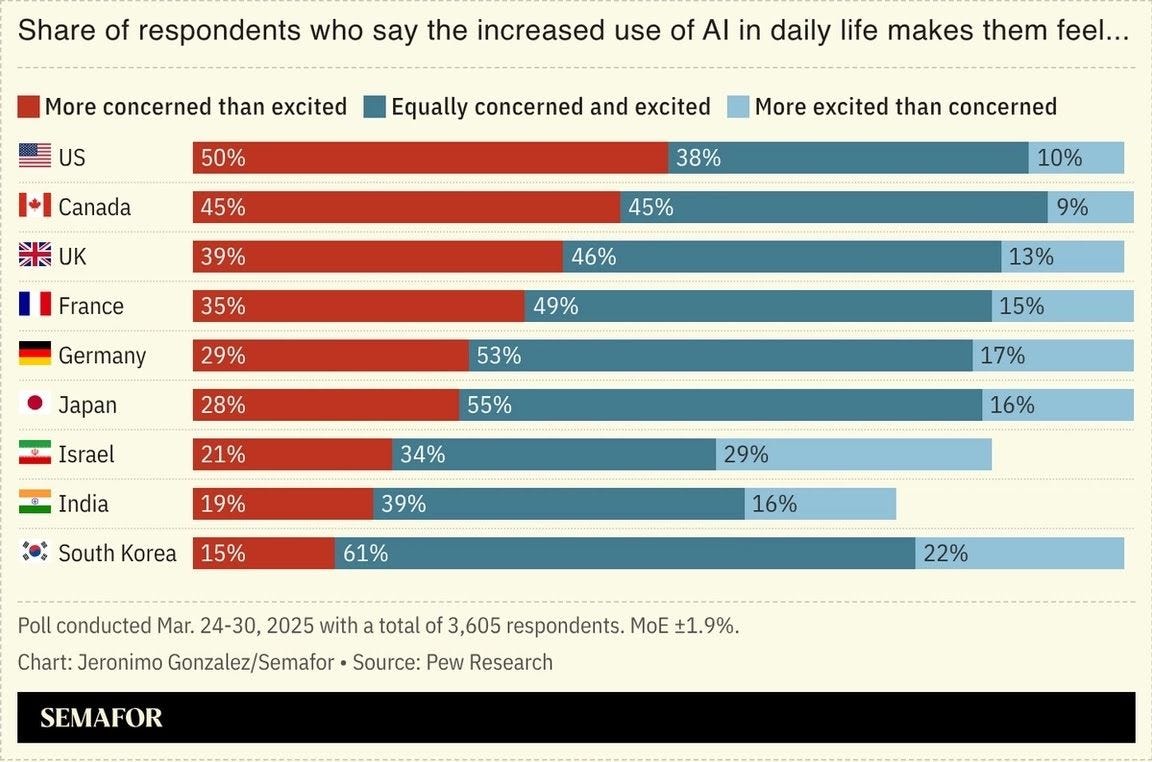
The context is well summarized here, and a rash of articles is emerging about how much opposition is building to AI, with Eric Schmidt and others getting booed at commencement speeches this week.
The AI people still seem to think this is a PR problem/reputation crisis. Um, good luck with that. I have been saying for a long time that you don’t fix reputation risk by managing reputation risk, and here we are.
Your whole self was never the point
My long read this week covers the corporate vibe shift from Peak Belonging to Peak Productivity, the emptiness of organizational culture, and why this is a crisis in the age of AI.
You can read it here:
It has sparked a ton of discussion and great reactions, including this wonderful email from Elizabeth Doty, which I am sharing in full with her permission:
Only some ideologies are framed as such: Beautifully said, so true, spot on! The best example I know is that Milton Friedman was making a moral argument
Missing the real question: Excellent and forces us to zoom out from “how to use AI.” I would argue that the real question is even broader: What is the economy for?Strangely enough, Marco Rubio has been quite articulate on this, and I would love to see his earlier thinking elevated:
Catholic Social Doctrine and the Dignity of Work: Marco Rubio on What the Economy is For
See also: Free Enterprise and the Common Good: Economic Science and Political–Economic Art as Complements
Thank you for calling out moral agency, especially of organizations
The dynamic you describe as companies manipulating people’s individual commitment by seeming to make real commitments to them. But of course, companies are not set up to manage those as real commitments. I think we fall for these like Lucy and Football, we want to believe it’s real this time.
And now, we will have AI/agents doing the same, communicating what is expedient. So, it’s time to consider: What would we do if we did not believe corporations (or AI) were capable of keeping commitments (regardless of what individual leaders intend)?
Finally, great to help us all remember what AI and narrow “productivity” miss. One thing I see is the complete blind spot around systems productivity vs individual. I assume you remember The Goal and Theory of Constraints? Or “relational coordination”?
It is substantive responses like this that make my week. Thank you Elizabeth, and to everyone who commented on the piece.
Bring back shame
It’s time to bring back shame.

As someone who spent over a year worrying that a reader might call me out over any tiny inaccuracy in my own book, I found this story jaw-dropping: “Book on Truth in the Age of AI Contains Quotes Made Up by AI.”
The brazenness of someone “investigating” made-up quotes in their own book is truly astonishing, but not as astonishing as this:
“In his statement, Mr. Rosenbaum said that if the episode “serves as a warning about the risks of A.I.-assisted research and verification, that is why I wrote the book.”
“These A.I. errors do not, in fact, diminish the larger questions that the book raises about truth, trust and A.I. and its impact on society, democracy and editorial,” he added.
I cannot even begin to imagine what it would be like to move through the world with this level of unearned confidence.

Resilience. No, really
In my Substack live with Sam Hartsock, we began by discussing how terms like “stakeholder engagement” and “resilience” have become laden with corporate bullshit. Then, we moved on to the question of what it actually takes to make them meaningful.
We unpacked why community-centered resilience is quickly becoming one of the most important topics in sustainability, especially as AI and data centers explode.
Sam shared what meaningful engagement can look like and feel like, and why some of the smartest resilience investment companies can make are local. Companies need to stop talking to the usual suspects, get out of their echo chambers, and actually start listening and making decisions. Community engagement also requires an entirely new set of skills, and no one has thought more about this than qb.
You can watch the discussion below as well as find qb. consulting’s newest publication called People-First Resilience: A Field Guide! Also, follow Sam here!

The reductive coverage of the Altman/Musk trial
The coverage of the Altman/Musk trial is more revealing than the trial itself. It’s framed as a test of character, but there is little cause for reassurance about either man.
The wider questions of governance, trust, and leadership are left unaddressed. The company structure isn’t relevant if one person can change it on a whim. And it is in both men's interests to frame this as a PR battle and distract us all from the wider questions about AI, especially with their IPOs coming up. But it won’t work.
I spoke to The Washington Post about some of this:
Alison Taylor, a professor at New York University who studies corporate responsibility and business ethics, said that the culture of Silicon Valley leads to company founders getting away with behavior that might be considered unacceptable in other industries, because they are seen as having special affinity for running their businesses.
“It’s an approach to innovation that is hero-driven and individualist, the idea is these people have got a secret sauce,” she said. “We might expect more scrutiny; it seems at the moment boards are asleep at the wheel.”

Oh Everlane
A lot has been written about apparel giant Shein buying Everlane this week. Just after AllBirds became an AI company. Is this the death of millennial aspiration?
Of course these stories will be made stories of sustainability, whether or not that’s the source of companies’ problems, because so many people can’t help credulously parroting the dominant “go woke go broke” narrative. And, they have generated a ton of commentary about how Everlane was still plugging consumption blah blah. This is fair enough on one level, but it illustrates another common tendency: nitpicking about how the efforts of these companies are/were imperfect. Getting stuck between these two binary arguments is where so many sustainable brands wind up.
One underrated issue with Everlane’s financial problems: its clothes are dumpy, middle-aged, and dull.

Gen Z truth
A Wired article excerpts NYU professor Steven Rosenbaum’s new book The Future of Truth: How AI Reshapes Reality. His take is that Gen Z has developed a new relationship with the truth, primarily social and emotional, which I find interesting but doesn’t sit quite right:
Participants described reacting emotionally first, discussing stories with peers second, and verifying details later, if at all. What looks like credulity from the outside is something more sophisticated from the inside. Gen Z has developed a distributed verification system, not institutional, not algorithmic, but social. Peer networks function as real-time editorial boards, stress-testing information against lived experience before it gets accepted or rejected. This has real implications for how we think about media literacy. The old model—teach kids to slow down, verify sources, check credentials—was designed for a different time. It assumed individuals made deliberate choices about what to believe. Gen Z’s information sensibility is collective and continuous. You don’t fix that with a checklist. You have to reckon with the environment that produced it.
Not sure about this at all. A friend commented that this is actually the behavior they see from older people, and I couldn’t agree more. This is not exclusively, or even primarily, a Gen Z issue.
While I certainly see a lack of institutional trust from my students, I also see a huge skepticism about narratives, and a focus on what is authentic. Not to mention an amazingly sharp radar for performative, manipulative content, and an obsession with real accountability.
Read my take in The Zero-Trust Economy, Moral Injury, and the Future of Business Ethics. More importantly, stay tuned for a wonderful response to this article from one of my students, out next week!
I’m off to Mexico City!
Lucky me. If you happen to be here, come and say hello. I am giving the keynote on Monday morning:
https://english.foronacional.com.mx/
And, it’s been a glorious week in the mountains, and I have a lot of wonderful new art in my house:


Have a gorgeous long weekend!
Alison XX
LOL at you coming off the top rope on Everlane, well done
Love this week’s post. Must reading for all.