

Corruption, American Style
Corruption in America is rampant. Trump is unapologetic. Is he correct that the public doesn't care? What would it take to change this?

“I found out that nobody cared. I'm allowed to." Trump, responding to questions from the New York Times about his children’s business deals, January 2026.
Let’s talk about corruption, American-style. Over the past year, Trump has launched a hostile takeover of the American state. I’m going to summarize the five ways the form and substance of corruption in America have advanced during the first year of the Trump administration. While the Trump family’s conflicts of interest have generated the most press, the broader dismantling of anti-corruption architecture has been humming along in the background, and the scale of these efforts is equally notable.
Because I’m going to grapple with definition and language problems later, let’s also provide a working definition of corruption for this piece upfront. Corruption is the abuse of entrusted power (most obviously, public office) for private gain. It includes bribery, but is much broader, and encompasses a number of practices that are legal and widely accepted in the US today.
Once we’ve covered where we are, I’m going to ask the more interesting questions. Is it true that Americans don’t care? If so, what might it take to change that?
Here’s where we are
Trump family self-dealing and conflicts of interest
Influence peddling
Regulatory capture
The revolving door
Carrots and sticks
How much do we care?
It’s been a slippery slope
The issue is partisan
Just World syndrome
This stuff is boring
Business and wilful blindness
What can be done?
Making the human connection
Avoid polarizing messaging
Provide a sense that this is addressable
Provide optimism and hope
Businesses must see that the level playing field has become quicksand
Focus on the bigger picture
Here’s where we are
Trump family self-dealing and conflicts of interest
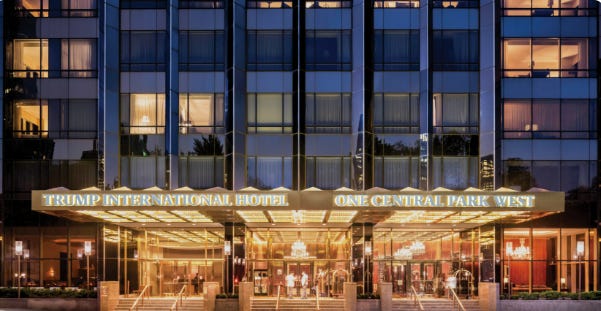
Over the last few weeks, a corruption story that has been simmering since late 2024 burst into the open. The Wall Street Journal published a deep investigation into the purchase of a 49% stake in World Liberty Financial, the Trump family’s then-nascent crypto venture, by Sheikh Tahnoon bin Zayed Al Nahyan (aka the “spy sheikh”), an Abu Dhabi royal. While the New York Times had been sniffing around the story since late 2024, the Wall Street Journal reviewed hard evidence, in the form of internal company documents.
The deal was four days before the inauguration, and was signed by Eric Trump. An additional US$31 million was to go to the family of Steve Witkoff, who co-founded World Liberty Financial, and had been appointed US envoy to the Middle East a few weeks earlier.
That’s not all. In May 2025, at a crypto conference in Dubai, the UAE-backed firm MGX (chaired by Sheikh Tahnoon) announced it would use $2 billion worth of USD1—the stablecoin launched by the Trump family’s World Liberty Financial—to finance a deal with the crypto exchange Binance (the founder of Binance, Changpeng Zhao, was pardoned for money laundering by Trump in October 2025). Two weeks after this, the Trump administration authorized the export of hundreds of thousands of advanced Nvidia AI chips per year to the UAE. These chips are essential for building AI data centers. Deals with the UAE had been resisted on security grounds for many years, given close links between the UAE and China.
Then, in July 2025, Trump signed the GENIUS Act into law, which brought stablecoin regulation directly in line with World Liberty Financial's business interests.
Essentially, World Liberty Financial now acts like a sort of private sovereign wealth fund.
This story has certainly generated a lot of mainstream press coverage, partly because the conflict of interest is so blatant. But World Liberty Financial is far from the only example of self-dealing by Trump and his brood.
The Trump Organization collects licensing fees from Dar Global, a Saudi-backed developer building Trump-branded hotels and golf courses in Dubai, Qatar, Saudi Arabia, and elsewhere. Trump's personal company, CIC Ventures LLC, sells bibles, watches, and other merchandise. Trump Media & Technology Group — which owns Truth Social, a platform that generates negligible revenue — was once valued at $5 billion based solely on Trump's name, though its stock has since fallen sharply. Forbes estimates Trump's net worth has roughly doubled since taking office, from $2.3 billion to around $6.7 billion — though a significant portion is unrealized paper wealth.
Then, there’s Jared Kushner. His firm, Affinity Partners, is estimated to have made more than US$2.5 billion from investments by Qatar, UAE, and Saudi Arabia in the last year, and this has tipped Kushner to billionaire status. This includes a US$55 billion deal between Affinity and the Saudi sovereign wealth fund to take Electronic Arts private, in the largest leveraged buyout in history.
Donald Trump Jr. has joined four boards in the last year: PublicSquare, GrabAGun, BlinkRx, Colombier Acquisition Corp. III. He’s on the advisory boards of four more (Unusual Machines, Polymarket, Dominari Holdings, New America Acquisition I Corp.). Eric Trump joined advisory boards of Dominari Holdings, New America, and Japanese Bitcoin company Metaplanet. Since then, the government has bought drones from Unusual Machines. Trump has launched a Trump Rx website, encouraging people to buy drugs directly from manufacturers, which benefits BlinkRx. And the younger Trumps have also taken the lead on the real estate deals discussed above.
Influence peddling
The Foreign Emoluments Clause prevents federal officials from accepting benefits from foreign governments without congressional consent. Trump has almost certainly violated this.
Many foreign government representatives have engaged in strategic gift-giving, mostly while hanging out at Mar-a-Lago. For example, a Swiss delegation gave him a gold bar. The most blatant example is Qatar’s gift to Trump of a 747 luxury jet worth US$400 million, which was accepted by Defense Secretary Hegseth, as an "unconditional donation." Since then, an unexplained transfer of US$934 million from the nuclear missile modernization budget has been linked to the retrofitting costs of the jet. After Trump leaves office, there is supposedly a plan to donate the jet to Trump’s presidential library foundation, which would be illegal.
Back in his first term, Trump Hotels is known to have accepted at least US$7.8 million from at least 20 foreign governments. Nothing much happened. Plus, this is a rounding error compared to the crypto deal above. In his second term, the Trump Organization has revised its ethics policy to allow dealings with foreign governments. The main pivot is in the reach and scale of the relationships, which are less focused on real estate, more focused on crypto, and much bigger.
Foreign policy has become more nakedly transactional. For example, the White House demanded access to rare earth minerals from Ukraine in exchange for US assistance. He has told advisors that defense support for Europe requires material commitments to American arms manufacturers.
Finally, according to the Brennan Center: “Since the 2024 election, Trump has sold access at $1 million-per-plate dinners at his Mar-a-Lago resort, one-on-one meetings with business leaders for $5 million, and a private dinner with the 220 individuals who spent the most buying Trump’s cryptocurrency — nearly $400 million in total.”
Regulatory capture
America has many (formerly) independent government agencies. The entire point of these is that they are insulated from presidential politics. So, one of Trump’s first moves, in February 2025, was a comprehensive effort to dismantle that independence. In an executive order, Trump asserted direct control over agencies including the SEC (securities regulation), NLRB (labor relations regulation), and FERC (energy regulation), requiring them to submit regulations to White House Office of Information and Regulatory Affairs before publication. Russell Vought, the head of the Office of Management and Budget in both Trump terms, is also now authorized to set ‘performance standards’ for the heads of agencies.
According to a statement from Public Citizen Co-President Robert Weissman, the order means independent agencies would become dependent on the “whims of Trump, [OMB Director Russ] Vought and their corporate buddies.” These agencies’ independence is “designed to enable them to perform these duties without undue political pressure from giant corporations, the super-rich and the super-connected.”
Trump also fired 17 government inspectors general on the night of January 24, 2025. This was just days after the inauguration, highlighting what a priority regulatory capture has been. The firings were illegal, which was acknowledged by a federal judge, who nonetheless refused to reinstate them. Notably, the Inspector General at the Defense Department had an open investigation into SpaceX. Then, in July 2025, Trump created a new ‘Schedule G’ category of federal employees who are political, and do not require Senate confirmation. This amounts to the creation of a shadow civil service.
Trump also dramatically slashed staff at the Department of Justice’s Public Integrity Section, which prosecutes public officials accused of corruption, and disbanded the FBI squad that investigates congressional misconduct and fraud within federal agencies. According to a Congressional Report on the white-collar retreat, since January 2025, over 25,000 law enforcement personnel have been diverted from white-collar crime units (fraud, money laundering, tax evasion) to immigration enforcement.
Most striking of all, Trump has paused enforcement of the Foreign Corrupt Practices Act (FCPA). There is a long history here. When pursuing a hotel deal with a notoriously corrupt oligarch in Azerbaijan in 2012, he described it as a “horrible law” and then tried to get Rex Tillerson to disband it during his first term (interestingly, FCPA enforcement actually increased during this period). In February 2025, an executive order paused enforcement of the FCPA for 180 days, and Pam Bondi also eliminated the DOJ’s KleptoCapture Task Force, Kleptocracy Team, Kleptocracy Asset Recovery Initiative, Corporate Enforcement Unit, and Foreign Influence Task Force—all at once. The SEC’s FCPA division was also disbanded. Enforcement has since been reinstated, but cases are now overtly aimed at supporting American interests, require political authorization, and must involve cartels or national security threats, not just corporate bribery.
The revolving door
Trump’s Cabinet is the wealthiest in modern history, and staffed almost entirely with executives and investors.
Trump has put industry executives in regulatory positions, ensuring that their interests dominate the agenda. Open Secrets identified 600 such people. For example, 43 former fossil fuel industry employees have been nominated or appointed to energy and environmental policy agencies. Prominent examples include Energy Secretary Chris Wright, and Audrey Robertson, who was nominated to lead the DOE’s efficiency and renewable energy office. Both are former fracking executives. Interior Secretary Doug Burgum is a billionaire tech entrepreneur, with deep, well-documented financial ties to the oil industry.
The most prominent example of the revolving door is, of course, Elon Musk’s tenure at DOGE. DOGE was created via an executive order, and Musk was made a “special government employee” which in practice meant access to a vast trove of federal data of immeasurable value. Trump said that Musk would “identify his own conflicts” and there is no evidence that he filled out the required ethics forms. SpaceX, for example, has US$20 billion in contracts with NASA and the Defense Department. Musk’s businesses are also regulated by a range of agencies, including the FAA, FDA, and National Highway Traffic Safety Administration. Trump granted Musk direct access to sensitive procurement data including access to trade secrets, and details on enforcement actions against his companies and their competitors. DOGE seemed to target issues of direct interest to Musk— for example, 20 people in the FDA who were investigating Neuralink were fired. The Trump-Musk relationship has, of course, been rocky, and Musk is no longer directly involved with DOGE, but the conflicts of interest here are still eye-watering.
Carrots and sticks
Trump has also pursued companies that go against his interests, via a mix of litigation and public shaming. He is currently suing the IRS for US$10 billion for leaking his tax returns. He has also successfully secured tens of millions of dollars from companies including Paramount, Meta, and ABC, all of whom decided the best idea was to settle claims that almost certainly had no legal merit. Much more on the agenda and background behind these decisions is here and here.
There are rewards to be gained, too. Trump has pardoned numerous of his political allies and further undermined corruption investigations. His pardons include all the January 6 defendants, the founder of Binance, as discussed above, and Ross Ulbricht, the founder of dark website Silk Road, who was convicted for money laundering, drug trafficking, and running a criminal enterprise.
I do not have space to do this topic justice, but here is a great article from this weekend in the New York Times that includes numerous specific examples, including one fraudster who stole US$660 million but had the charges dropped after donating US$2 million to Trump-allied political action committees.
How much do we care?
Actually, Trump is wrong. Americans do care about corruption. One recent survey found that a majority of Americans view the government as “corrupt and rigged against [them],” while another poll found that a full three-quarters of Americans believe the government is “corrupt.”
So, the issue is not perception, it is efficacy. Perception without efficacy produces cynicism, not action. And vague exhortations to hold leaders accountable can seem inadequate, given the scale of the trouble we are in.
How did we get here?
It’s been a slippery slope
In 1976, the US ranked among the least corrupt democracies by every measure; by 2024, Transparency International's Corruption Perceptions Index ranked the US 28th. In 2025, the US slipped to 29th, its lowest-ever score since the index began in 1995.
The most obvious fork in the road that brought us here is, of course, the 2010 Citizens United decision, but for decades, “the Supreme Court has whittled down campaign finance regulations and narrowed the legal definition of how the influence of money in politics can count as corruption,” as the Brennan Center for Justice explains in its piece What is Political Corruption and What Can We Do About It?
Much of what is allowed here is illegal in other countries, but this often goes unnoticed in America. We still tend to think of corruption purely as retail bribery, consisting of envelopes of cash changing hands in developing countries. We have a culture of opportunity and innovation, along with a relative lack of bureaucratic red tape—many people automatically associate such red tape with corruption. It may also be connected to how litigious society is in general—the law is so central that broader ethical questions are often outside the frame.
Here, the story of the American chapter of Transparency International is illustrative (disclosure: I briefly worked for the UK chapter in 2010-11). Transparency International’s chapters function as semi-independent entities. There was longstanding tension between the headquarters in Berlin and the US chapter, which, in contrast to all other chapters, declined to focus on domestic corruption, and made all of its work internationally-focused. This was almost certainly because the board, mainly comprised of influential lawyers who earned a living investigating foreign bribery, didn’t want to put itself in an uncomfortable position. It was also heavily funded by corporate donors, many of whom were trying to recover from their own foreign bribery scandals. After years of tension, Transparency International’s headquarters disaccredited the American chapter in 2017 (a new chapter was eventually established in 2020).
Finally, the gradual blurring and dissolution of guardrails between business and politics has been a slow drip, not a geyser. We are now so socialized to the idea that business influences the political process that it now seems a fixed fact of life, not an anomaly requiring urgent correction.
The issue is partisan
Corruption is a complex topic, and it takes many forms. The most prominent is petty bribery, which is often referred to as facilitation or grease payments. For example, you pay a police officer to avoid a traffic ticket, or pay a bouncer to skip the line. This is still less pervasive in America than elsewhere. Where Trump has focused is institutional corruption (the police officer gives a cut of the bribe to his boss, the bouncer also owns the club) and systemic corruption (the police chief controls who gets contracts to supply uniforms and weapons, the club owner writes the fire codes.)
Although the ambition and scale of Trump’s corruption is unprecedented, it is also not entirely new. Republicans spent much of the last few years investigating Hunter Biden, and allegations of corruption dogged Hillary Clinton’s 2016 presidential run. Again, I’m only scratching the surface here. Let’s just say I’m old enough to remember when Bill Clinton pardoned Marc Rich.
I cited research above that Americans do care about corruption. However, there is nuance here. Americans overwhelmingly perceive systemic corruption (75-80% in Gallup’s annual governance tracker say government corruption is “widespread”), but when asked about specific corruption by a named politician, answers split almost perfectly along party lines. AP-NORC polling consistently shows this. This asymmetry is precisely the problem: people share a general outrage but cannot agree on specific instances because partisan identity shapes their judgments. Trump is counting on that partisan filter, not genuine public indifference.
While the American public is angry about corruption writ large, the term is deployed to attack anything that smacks of impunity for the powerful, whether or not it is legal or justified. So now, corruption is used to describe everything from the 2008 financial crisis to Jeffrey Epstein’s business network, and indeed any indication that powerful people have impunity. People get exhausted, and switch off.
Just World syndrome
Another issue here is the uniquely American brand of aspiration. Canadian author Ronald Wright said in 2004: “John Steinbeck once said that socialism never took root in America because the poor see themselves not as an exploited proletariat but as temporarily embarrassed millionaires." (In fact, he slightly misquoted Steinbeck, but the point stands.)
In other words, America’s identity is as a land of opportunity, where hard work brings financial success, and rich people deserve their fortune. While this perception is fading among younger generations, it is still widely accepted, and blunts anger or scrutiny.
Also, the form Trump’s corruption has taken — dispersed, technical, laundered through LLCs and executive orders — is specifically optimized to evade the psychological triggers that generate moral outrage.
