


Every month, I receive several messages from aspiring authors seeking advice on finding an agent or publisher, or on some aspect of writing, editing, and promoting a book. So I thought it was about time to consolidate my guidance in one place. I’ve tried to offer advice that might apply generally rather than just to me, but I’m sure I’ve only partially succeeded.
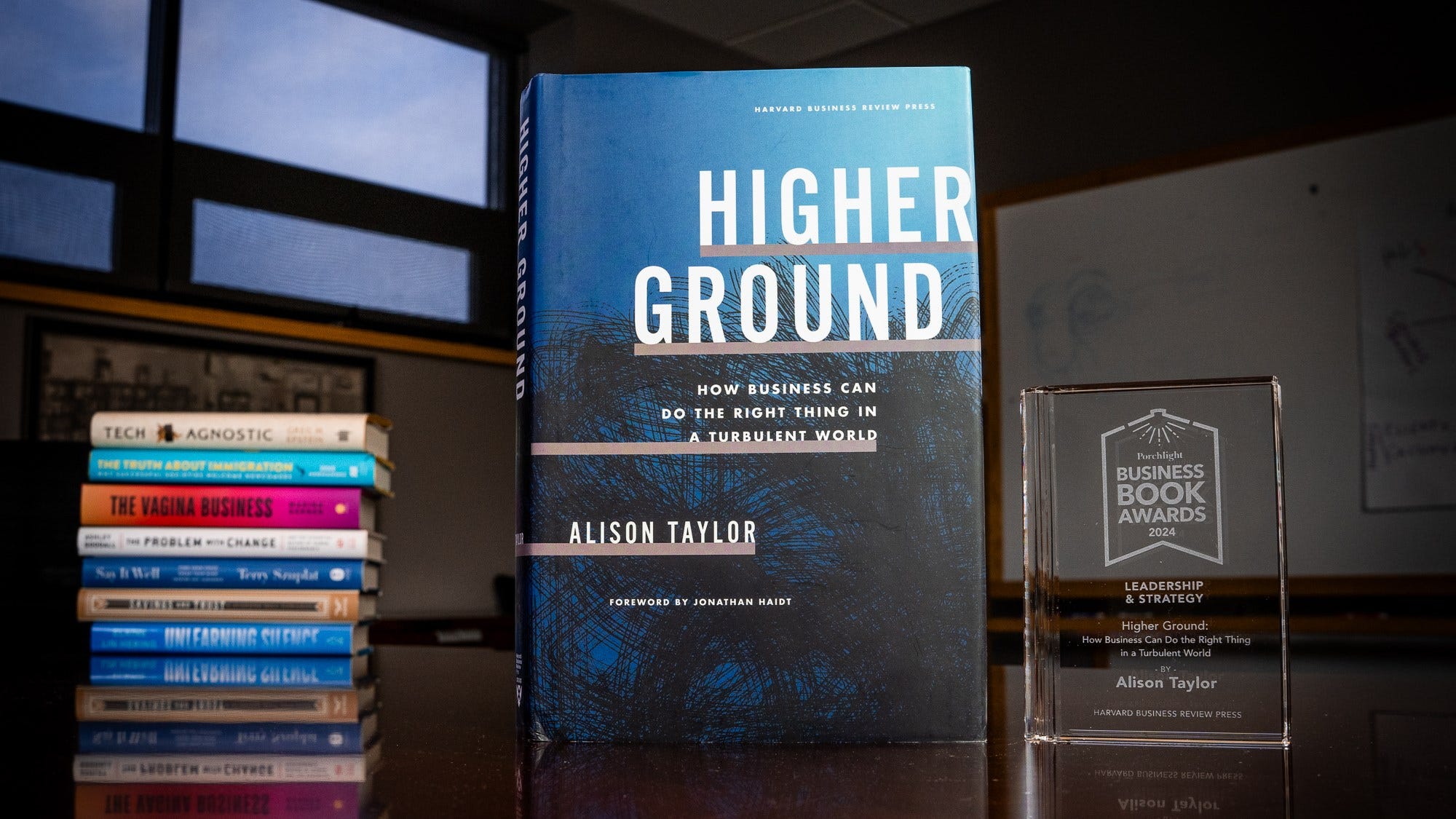
My first book, Higher Ground: How Business Can Do the Right Thing in a Turbulent World, was certainly not a mega-hit. It made no bestseller lists (appearing at the top of an obscure topic list on Amazon does not count!). Nonetheless, it was published by Harvard Business Review Press, and I even received a small advance. I hit my stretch goal of selling 10,000 copies in the first year. Higher Ground was listed by the Financial Times as one of the ten best business books of the year and won the Porchlight Award for the best leadership and strategy book of 2024. I’d still never describe myself as a writer, but I should probably get over this and share what I discovered and experienced during this long and intense process.
Here’s the guidance I wish I’d had.
Where to begin
The first thing to say is that this will be harder and cost more (in every sense) than you think. Like a property renovation! It took around two and a half years from the publisher saying yes to my proposal to my submission of the final proofread galleys. I was working full-time and going through the first stages of a horrible divorce. I also worked and reworked everything far too much, but for me this was necessary. Perhaps you won’t feel the need to iterate as much as I did.
The second thing to say is that if you want a mainstream publisher (and even if you don’t), you need a social media presence as well as a great proposal. I appreciate how irritating this is. But if I were embarking on a book today, I’d first spend effort developing a clear online identity and loyal network. This also means clarifying your remit. I cover all aspects of business risk and responsibility. No one needs to hear what I think about tariffs or geopolitical conflict, for example.
My social media presence turned out to bring enormous practical benefits. More on this a bit later.
If you’ve already got a good online presence, it’s worth thinking about how you will proceed. Self-publishing is potentially more lucrative, it is also going to be much harder to get attention for your book. But if I were to do this again, I’d take that path seriously. My publisher was wonderful, and the whole team a joy to work with. But it’s absolutely true that you do the work and they get the money.
Then there is the type of publisher you want to aim for. ‘Trade’ publishers are the big mainstream houses, while academic publishers are smaller and may be more receptive to something more nerdy and niche. There are a load of specialist small presses. A lot depends on what you are hoping to achieve. HBR Press was certainly the best I could have hoped for, and its related magazine and podcast helped a lot with promotion.
I didn’t have an agent, though I do have one now. Honestly, I didn’t feel powerful enough to find one or to negotiate. I also benefited from a warm intro from a much more famous colleague. In the end, getting a deal is a mix of luck and persistence.
The format of a book proposal is consistent. Any publisher will want an overview, a chapter-by-chapter outline, a discussion of your audience and why only you could write this book, a review of similar works and why your book is different, and so on. In the end, my outline was only 70% accurate, but was a constant reference point.
I began the first draft thinking I already knew what I wanted to say and that I just needed to put everything on paper. I also assumed that, because I regularly write long articles, I could think of it as a series of articles strung together. Idiots write books every day, right? This was an embarrassing and regrettable miscalculation.
Because it was my first book, my editor also wanted the introduction and first two chapters in the first six months. I gave them this, and it was harrowing, because I still didn’t quite know where I was going. If you can get away with it, I’d advise writing the beginning right at the end, during the phase when you pull it all together.
The writing process
I am not a morning person. So, I thought the best approach would be to clear my other calls and tasks, and then have the rest of the day to focus on writing. In the end, this didn’t work, because by then my brain was full of those other tasks, and my attention was diluted.
After a few months, I realized that writing should be the first thing you do, while your mind is clear of the detritus that accumulates throughout the day.
I tried the app Scrivener early on. Many people swear by it, but it did not work for me, and I wasted much time. I wrote in Google docs instead, with a folder for each chapter.
Many people set a daily word count goal. That didn’t help me, not least because of my tendency to iterate, but I did find that three to four hours was the most I could spend writing per day. To be sure, you can read, do research, conduct interviews, and so on during the rest of the day, but any notion I had of churning away for eight or nine hours had to be quickly abandoned. So, pace yourself, and don’t beat yourself up if you don’t get as much done as you dream of.
My proclivities meant I often started a chapter repeatedly, drawing on earlier drafts. Is this efficient? No. Would I do it again? Yes. By the fifth or sixth effort, I’d finally get clear. Find out what works for you as a process, and then stick with it.
I recently read an interview with Zadie Smith, where she said that the first 5 to 12% of a project is the hardest. This is when it is easiest to give up. I fully concur, and if I had not had a publishing deal, I’m not sure I would have continued. I found the writing process daunting and overwhelming until I was at least two-thirds through.
The research was painful, mostly because I didn’t know when to stop. I had the help of a brilliant intern, but I spent most of the writing process worrying that I was ignorant of some big concept or idea. It didn’t help that my book is broad rather than deep, with each chapter covering a huge topic. One of my biggest dark fantasies was that once the book came out, I would be bombarded with expert critics berating me for what I’d missed. None of this ever happened! In fact, the book was commended for its deep research. I spent too much time trying to justify my position to these made-up, faceless critics. The result was more rigor, but a lot of unnecessary angst.
Emotionally, this was a rollercoaster. I often felt good about what I’d written when I wrapped up writing for the day around lunchtime. By 5pm or so, I’d reread the draft and become convinced it was awful and that I was a failure. This cycle of joy and despair continued until the very end.
Other than making myself sit down and write every weekday, the best thing I did was to take a long walk every evening without my phone. That was where the best processing happened, and where I got my best ideas. So, build in time to digest and turn things over in your mind. It will really help you.
Aside from the emotional toll, the hardest part was figuring out what I needed to explain to the reader. What’s obvious? What needs spelling out? What background knowledge can and should I assume? What’s a tangent versus a necessary contextual point? These questions will come up whether you are writing about Russian history or about how to be a better leadership coach.
A few things helped on this front, in the end. The first was to develop a vision of an ideal reader. In my case, it was a student in my MBA class. When I was struggling to figure out whether my point was too obvious or too obscure, I’d imagine myself explaining it to them in a classroom. You might have a different reader in mind, but it helps to keep a vision of them in your head at all times. It also helped that I could test things in a real classroom as I went along. That said, I found it impossible to write and teach on the same day.
The second thing that really helped, believe it or not, was posting on LinkedIn. If I was wrestling with a tricky idea and wanted to see whether it would resonate or was too wonky, I’d road-test it with a post. I learned so much from the comments and reactions about where my explanations should begin and end. Plus, this process helped further build my network, which was so helpful when it came to promotion.
The final huge challenge was structure. I switched up the first and second halves about halfway through, which was the right decision. It’s super hard to keep the whole flow in your mind at any one point. That last stage requires much iteration, rigor, and careful attention to repetition. I feel like I was about 90% done for about nine months.
I didn’t use an LLM once. I wrote Higher Ground just before the big AI boom. If I were to embark on writing a second book, I would use an LLM to help with editing and structure. But never, ever, would I use it for a first draft.
The editing process
I had the benefit of a very harsh editor throughout, who helped with fact-checking, flow, and content, as well as grammar and style. A great, independent editor is a good investment. An LLM can cover your grammar, but I’d still have a human editor again.
My first draft was complete in February 2023. HBR Press then conducted a peer review, with five reviewers. I know who some of them were, but not all. Two of them really did not like the book, and there was much sharp criticism, which was painful, but valuable.
The overarching advice was to turn the snark way down, and in retrospect, I’m glad I listened, as the book was aimed at practitioners. But, I still dream of a future work where I can be as snarky as I want!
My second draft was complete by early July 2023. Then, to my horror, my editor told me I had to cut 8,000 words before I could submit. I did this in four days, and actually I think the time pressure helped. The main point here is that your editor may not be thrilled if you go over the word count, and more is not necessarily better.
HBR Press did a thorough copy edit, though mine was very clean, thanks to my editor. In general, I would not assume any publisher will do as much editing as you hope or think.
The promotion process
After two years of effort and emotional turmoil, promotion may feel like the last thing you have the energy to do. But, just as you limp to the finish, a chorus of voices will tell you: “Now the hard work really starts!”
OMG. Seriously? I get it. But I hear from a lot of authors that they plan to just ‘put it out there and see what happens.’ Even if you have a great publisher, I don’t think this is a good idea. As with the writing and editing, the promotion is ultimately on you as the author, and if you underestimate the help you will get, you are less likely to be disappointed.
You need to go out and seek endorsements. I thought the publisher would handle this, but no. I cringed at the idea of asking, but hardly anyone said no. Do this as early as you can. Big names in particular will need time. But this is another effort that’s well worth it.
Higher Ground came out on February 13, 2024. I started working on promotion in around October 2023, just as I was reviewing the final galleys.
I got three proposals from publicists in the US. This stuff is expensive, and you should plan on around US$5,000 per month for each month they work for you. A campaign is going to be four months at least, and they need time to ramp up and down. I made the investment reluctantly, because I’d put so much effort in already. In the end, I’m glad I did. I also went for a publicist who was a bit smaller and more niche, but who seemed to ‘get’ the book. I certainly considered bigger and more expensive publicists, but wound up feeling that it was a bad idea to be fighting for airtime with Yuval Noah Harari. I also had a publicist in the UK, who was amazing and very cost effective. You do not necessarily get what you pay for here.
What helped just as much, to my surprise and delight, was a grassroots campaign to promote the book. Based on advice from the brilliant Dorie Clark, I created a launch team, gave out early galley copies, and had a few hundred people ready to post reviews on Amazon on launch day. This is about getting the attention of the algorithm, and no, you should not consider yourself ‘above’ this.
I also hosted and paid for a big launch party. I thought it terribly important this was on the actual launch day. In the end, it wasn’t, and I’d give it a week or so next time. The party was a total joy, but I was frazzled.
This was all a lot of effort, but it paid off. For around a year, people shared reviews, pictures of Higher Ground in stores, and their own thoughts and reactions. This was a total joy, and helped so much with sales. One reader, Chad Smith, even posted a chapter-by-chapter review! All of this is way more valuable than a quote in a news article, though those don’t hurt either.
Finally, I did a ten-city Europe book tour in the summer of 2024. I organized this myself, with a mix of talks, conference invitations, and so on. I mostly got my travel covered, and some book bulk orders, and it was a worthwhile investment. It helped me keep the buzz around Higher Ground going, for longer than I ever hoped for.
I made the mistake of thinking of a book launch like a wedding or graduation, with one big day. There were many big days! Choosing a cover was amazing; the designer got it right the very first time. Unpacking the box with the first physical copies was another thrilling moment. Launch day was another. But this is much more like surfing a long wave. You need to preserve your energy, and plan accordingly.
As I mentioned earlier, I just about broke even on this book, if we count direct sales revenue. That’s a lot of unpaid labor. But, if I take a broader view, this was lucrative. I doubled my speaking fees, I won great advisory contracts, and built an entirely new profile and presence. So, you can make money! It’s just unlikely to be from the book itself.
I would do it all again, no question.
And now that I know what’s involved, I’m waiting until an idea utterly consumes me. For now, real-time reactions seem more valuable, which is why I’ve come to Substack.
I want to help with your projects, in the meantime. Be in touch!
Alison - this is an absolutely brilliant and spot on summary of what it takes to propose, research, write, rewrite, edit, finalize and promote a book!! With my 6th book launching in February 2026, I wished I had this advice earlier too!! I’ve stumbled through all of the above fear, loathing, highs, lows, angst and elation and could not agree more with you on all of it! And the part about having great endorsers - I couldn’t agree more as well - yours means the world to me!!🙏🏼🙏🏼
Thank you for this pragmatic, heart felt advice. It really makes publishing feel possible. Appreciate it! And congratulations on bringing your book to life. 🙌🏼